Buying Guide
The Essential DIY Mechanic Tool Kit
You don't need 200 pieces to change your own oil, swap a set of pads, gap plugs, or drop in a new battery — you need about 40 of them, and they have to be the right 40. Here's what actually gets used for the maintenance jobs that make up most of DIY wrenching, and which boxed sets deliver real tools instead of padding the piece count.
Updated July 2026
How to Choose a Tool Kit
Oil changes, brake pad swaps, spark plugs, air and cabin filters, and battery terminals cover most maintenance a DIYer will ever do. None of it requires a hundred specialty tools — just a handful of good ratchets, a well-chosen set of sockets, some combination wrenches, and a couple of screwdrivers and pliers. Everything else in a boxed set is occasionally useful at best, filler at worst. Here's what actually matters when picking a kit.
Drive sizes: 1/4", 3/8", and 1/2". These describe the square drive on your ratchet and its sockets — not the fastener size. 1/4" drive suits small stuff: interior trim, accessory hardware, tight spaces. 3/8" drive is the workhorse, covering most bolts on a car from valve covers to caliper bolts. 1/2" drive is for high-torque fasteners: lug nuts, axle nuts, crank pulley bolts, suspension hardware. A starter kit needs 3/8" at minimum; a complete one has all three.
6-point vs. 12-point sockets. A 6-point socket contacts a hex head on all six flats, spreading the load so it's far less likely to round off a stuck or rusted fastener. A 12-point socket has twice the contact points, so it fits back on at twice as many ratchet angles — useful in tight clearance — but grips less per point and rounds worn heads faster. Make 6-point your default; keep 12-point as a nice-to-have for spots where swing room is the real problem.
Deep vs. standard sockets. Standard sockets are your everyday driver — more clearance, less flex under torque. Deep sockets cover two jobs: spark plugs (extra length plus a rubber insert to grip the porcelain) and nuts sitting proud on a long stud, like strut tower nuts. A kit without deep sockets can't actually do a plug job, whatever the box claims.
Metric-first is the reality now. Every major automaker sold in the US — Ford, GM, Stellantis — has been metric for decades. SAE (standard/imperial) fasteners mostly show up on older classics, some aftermarket parts, and occasional trim. Buy metric-heavy or metric-only as your core, and add SAE only if you're working on something old enough to need it.
Piece counts lie. A "200-piece" set sounds like twice the tool of a "100-piece" set, but usually isn't — it's the same core wrapped around hex keys, screwdriver bits, and tiny adapters counted individually to inflate the box number. Eighty of those two hundred pieces can easily be hex keys and bits you'll use twice. Judge a set by ratchet quality (smooth engagement, fine tooth count, no slop) and socket coverage — every size you need, in the drives you need, in deep and standard — not by the number on the case.
What no boxed set includes. Even a great mechanics set stops short of tools every DIYer eventually needs: a torque wrench (lug nuts, drain plugs, and head bolts are all spec'd in ft-lbs or Nm — guessing risks stripped threads or a wheel backing off), a breaker bar (for the stuck lug nut your ratchet can't crack), and a jack plus real jack stands (never trust a scissor jack alone to hold a car up while you work under it). We cover torque wrenches in our torque wrench guide, and brake-specific tools — C-clamps, caliper tools, bleeder kits — in our brake job tools guide.
Our Picks

Best All-Round Starter Set
DEWALT DWMT81534 Mechanics Tool Set
The set most first-time DIYers should start with. The ratchets have smooth, positive engagement that doesn't feel like a toy, and the socket coverage is genuinely useful — deep and standard, across both 1/4" and 3/8" drive — so you can do a plug job and a brake job out of the same case.
Pros
- Solid ratchets with smooth, reliable engagement
- Deep and standard sockets in both 1/4" and 3/8" drive
- Recognizable brand backing and reasonable warranty support
Cons
- The case is bulky — plan real shelf space for it
- Like most boxed sets, it still carries some filler pieces

Best Ratchet & Socket Core
TEKTON 3/8-Inch Drive Socket Set
If you'd rather build your kit piece by piece instead of buying a case full of stuff you'll never touch, start here. TEKTON's 3/8" set is almost entirely tools you'll actually use — clear, laser-etched size markings, tight tolerances that don't slip on a stubborn bolt, and no bit-driver padding inflating the box. Best dollar-for-dollar core of any set here.
Pros
- Excellent quality-per-dollar; tight, precise fit on fasteners
- Clear, easy-to-read size markings
- No filler — nearly every piece in the box gets used
Cons
- 3/8" drive only — you'll need to add 1/4" and/or 1/2" separately
- No wrenches or screwdrivers included; it's sockets and ratchet only

Best Ratcheting Wrenches
GearWrench 120XP Flex-Head Ratcheting Wrench Set
Combination wrenches you reach for constantly — hose clamps, brake line fittings, bolts buried where a socket and ratchet won't fit. The 120XP's fine-tooth ratcheting arc needs only a few degrees of swing to bite the next tooth, exactly what a cramped engine bay demands, and the flex head lets you angle around obstacles instead of pulling the part for a straight shot.
Pros
- Fine-tooth ratcheting arc works in very tight swing spaces
- Flex heads adjust to the angle instead of forcing you to
- Noticeably faster than swapping a wrench end-for-end repeatedly
Cons
- Priced like a whole budget mechanics set on its own
- The ratcheting mechanism is a precision part — don't use them as a breaker bar or hammer
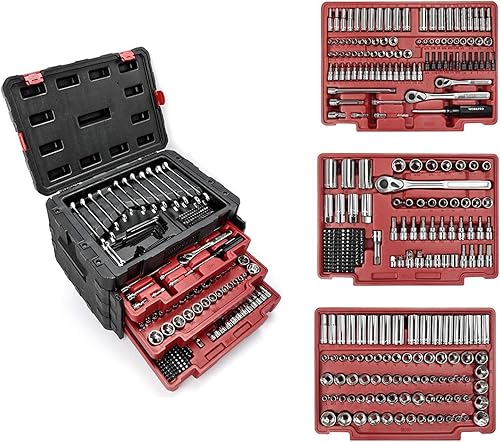
Best Budget Breadth
WORKPRO 450-Piece Mechanics Tool Set
This is exactly the kind of set our piece-count warning above targets — but that doesn't make it a bad buy, as long as you know what you're getting. For the price, coverage is huge: metric and SAE, multiple drives, a full spread of hand tools. It's a reasonable first kit for someone who just wants "a toolbox that handles most things," or a dedicated set for the trunk or a second car.
Pros
- Enormous size and fastener coverage for very little money
- Reasonable as a first kit, a gift, or a dedicated trunk/garage-two set
- Metric and SAE both included
Cons
- Tool feel and finish are a step below TEKTON, GearWrench, or DEWALT
- The piece count is padded with bits, adapters, and hex keys — real socket coverage is smaller than 450 suggests
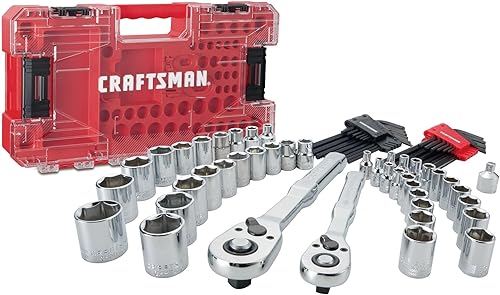
Best Storage Foundation
CRAFTSMAN VERSASTACK Mechanics Set
Storage is the part of tool buying nobody thinks about until they own three overlapping sets and no good way to keep them organized. VERSASTACK's modular cases click together into one stack, and because Craftsman sells more tools in the same case system, this stops being "a tool set" and becomes the foundation a whole garage gets built around — add a wrench module, a plier module, a deep-socket module, and they all still stack the same way.
Pros
- Stackable, modular cases that click securely together
- Grows cleanly as you add more Craftsman VERSASTACK modules over time
- Keeps a growing tool collection organized instead of scattered across drawers
Cons
- Part of what you're paying for is the case system, not just the tools
- Not the deepest single-box tool selection on this list
Comparison at a Glance
| Set | Core strength | Piece quality | Storage | Best for |
|---|---|---|---|---|
| DEWALT DWMT81534 | Balanced ratchets + sockets, two drives | Solid, name-brand | Bulky molded case | First complete starter set |
| TEKTON 3/8" Socket Set | Best-in-class socket core | Excellent, no filler | Compact tray | Building a kit piece by piece |
| GearWrench 120XP | Ratcheting wrenches for tight spots | Premium | Wrench roll/tray | Engine-bay work sockets can't reach |
| WORKPRO 450-Piece | Broadest raw coverage | Budget-tier | Large molded case | First kit or a spare/trunk set |
| CRAFTSMAN VERSASTACK | Modular, expandable core | Solid, mainstream | Stackable system | Building an organized garage long-term |
FAQ
Do I need a torque wrench right away?
Not for your very first job, but plan on adding one quickly. Lug nuts, oil drain plugs, and especially head bolts and suspension hardware are all spec'd to a torque value, and going by feel risks a stripped thread, a leak, or a wheel that comes loose. See our torque wrench guide for what to buy.
6-point or 12-point sockets — which do I actually need?
6-point for anything you expect resistance on — lug nuts, exhaust hardware, anything that looks even slightly rusted. 12-point earns its keep in tight spots where a 6-point socket can't get enough swing angle on the ratchet. Most DIYers are best served by a 6-point set as their primary, with 12-point as a secondary nice-to-have.
Is a 400+ piece set actually worth it, or should I buy fewer, better pieces?
Both can be right, depending on the goal. A big budget set gets you broad coverage cheaply and is fine as a first toolbox or a dedicated second set. If you're building tools you'll rely on for years, a smaller set with real ratchet quality and no filler — like a dedicated socket set plus a good wrench set — tends to serve you better than a padded 400-piece box.
Do I need SAE (standard) tools too, or just metric?
For most vehicles on the road today, metric-only covers you — Ford, GM, and Stellantis have all been metric for decades. Add SAE if you own something older, work on small engines or older American iron, or run into odd fasteners on aftermarket parts and trim.
Ready to Put the Kit to Work?
If a warning light sent you down this road in the first place, look up the code first in the free WrenchConnect code library before you buy tools for a job you might not need — or if it's more than you want to tackle yourself, find a trusted local mechanic instead.