Buying Guide
Best Torque Wrenches for DIY Auto Work
Guess wrong on "how tight is tight enough" and you usually don't get a warning — you get stripped threads, a warped rotor, or a wheel that works loose. Lug nuts, spark plugs, brake hardware, and oil drain plugs all carry a torque spec for a reason: an engineer picked that number, not gut feel. A torque wrench is cheap insurance against overtightening and undertightening alike. Here's what's actually worth buying.
Updated July 2026
How to Choose: Click vs. Beam vs. Split-Beam vs. Electronic
Every torque wrench works one of four ways, and picking the wrong mechanism for how you actually use a tool is the number-one source of buyer's remorse — same lesson as picking the wrong tier of OBD2 scanner.
Click wrenches are what most people picture: dial a number on a micrometer-style handle, pull until it clicks at your target, then stop. Fast and intuitive, but a spring holds the mechanism under preload internally, which is exactly why click wrenches come with a storage rule (more below). Beam wrenches have no click and no preloaded spring — a flexible steel beam bends under load while a pointer sweeps a printed scale. Dead simple and it can sit at any setting indefinitely, but you have to watch the pointer while pulling, which is awkward in tight engine-bay spaces. Split-beam wrenches refine that idea: dial in a number, pull, and an indicator confirms when you've hit it, without the eyes-on-the-scale act of a plain beam wrench. Because the calibration spring in a split-beam design isn't under the heavy tension a click wrench's drive spring is, there's no "back it off after use" ritual — set it and put it away. Electronic wrenches use a strain gauge and digital readout, with audible beeps and/or LED flashes at target. The display switches between ft-lb, in-lb, Nm, and kg-cm without conversion math, and most store a peak-reading memory. Trade-off: batteries, and a sensor that doesn't love being dropped.
Drive size and range matter as much as mechanism. A 1/2-inch wrench is the wrong tool for a 15 ft-lb fastener like a valve cover bolt — it's calibrated for a much higher-load range, and down at the low end of what it can technically dial in, accuracy gets shaky. Every torque wrench is most accurate in the middle third of its stated range, not the extremes. That's why most home mechanics eventually own two: a 1/2-inch for lug nuts and suspension, and a 3/8-inch for spark plugs and smaller hardware. Buying just one today? Match it to your most common job — for most people that's lug nuts, so 1/2-inch drive is the default first purchase.
Storage rules aren't optional on click wrenches. A click wrench holds its calibration spring under preload any time it's set above the lowest marking. Leave one sitting in a toolbox for months at "80 ft-lb" and that spring can take a permanent "set" that quietly shifts calibration off from what the dial says. The fix costs nothing: after every use, dial the handle back down to its lowest marked setting before storing it. Five seconds, and it's the single habit that keeps a budget click wrench accurate for years. Beam and split-beam types skip this entirely — no high-tension spring sits loaded in the drive path.
Calibration, realistically: shops recalibrate on a fixed schedule for liability and traceability, not because tools drift wildly on their own. For home use, good habits matter more than a calendar — back off click wrenches after use, never use one to break a bolt loose, don't drop it. If a reading ever starts feeling obviously off, or the wrench took a hard drop, that's when to get it checked or retire it.
Never use a torque wrench as a breaker bar. Breaking a stuck or over-tightened fastener loose takes far more force than tightening one to spec, and forcing a torque wrench past its range — or slamming it in reverse against a seized fastener — can spring a click mechanism, bend a beam, or overload an electronic sensor in ways a calibration check won't always catch. Break it loose with a breaker bar or an impact first, and bring in the torque wrench only for the final, correct-spec tightening pass.
Our Picks

Best Value Click (1/2-Inch)
TEKTON 24335 1/2-Inch Drive Click Torque Wrench
The default first torque wrench for most driveways: lug nuts, suspension bolts, and general 1/2-inch drive work. It has the crisp-enough click and reversible ratchet head you need without paying for pro-shop tolerances you won't notice at home.
Pros
- Affordable entry point into real torque control
- Covers the fasteners most home mechanics touch most: lug nuts, suspension
- Reversible ratchet head, adjustable micrometer-style handle
Cons
- Click feel is subtler than pricier pro-grade wrenches
- Like any click wrench, you must dial it back to its lowest setting for storage — skip that and calibration can drift over time

Pro-Grade Click
CDI 2503MFRPH 1/2-Inch
CDI is Snap-on's dedicated torque tool brand: tighter tolerances, a crisper and more repeatable click, and a locking collar that doesn't drift between uses — the step up once consistency matters more than price.
Pros
- Built by Snap-on's torque-specific brand — noticeably tighter tolerances
- Crisper, more repeatable click than budget wrenches
- Ships with its own calibration paperwork as a baseline reference
Cons
- Costs several times what the Tekton does for a similar nominal range
- Still needs the same storage discipline — back it off after every use
- Overkill if you're only doing lug nuts a couple times a year

Best Electronic
GearWrench 85077 1/2-Inch Electronic
A digital readout takes the guesswork out: watch the live number climb as you pull, get an audible beep and flashing alert right at spec, and switch between ft-lb, in-lb, Nm, and kg-cm on the fly.
Pros
- Live digital torque readout plus audible/visual target alert
- Switches between ft-lb, in-lb, Nm, and kg-cm without conversion math
- Peak-hold memory to confirm a reading after the pull
Cons
- Runs on batteries — dead battery means no wrench
- Treat it gently; the sensor is less forgiving of drops than a mechanical click wrench
Best Digital Alternative
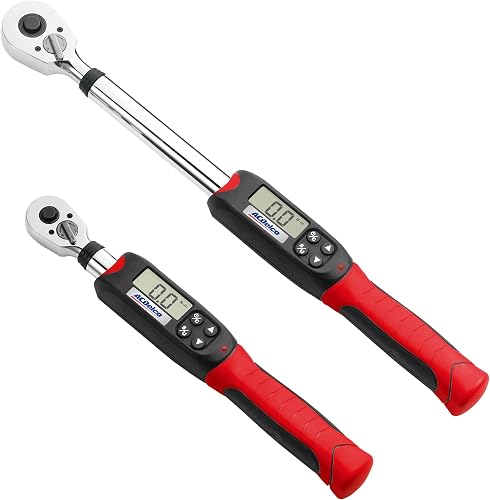
ACDelco ARM601-4 1/2-Inch Digital
A second solid digital option with its own personality: audible beeps plus a three-stage LED (approaching, at, over target) instead of relying on sound alone, and it ships with a calibration certificate so you have a documented starting point.
Pros
- Audible plus LED target alerts — easy to catch in a noisy garage
- Includes a calibration certificate as a documented baseline
- Memory function to review the last reading
Cons
- Same electronic caveats as any digital wrench: batteries, drop-sensitivity
- Housing feels more plasticky than the metal-bodied click wrenches above

No-Fuss Split-Beam
Precision Instruments PREC3FR250F 1/2-Inch Split-Beam
For people who hate remembering storage rules, this is the answer. The split-beam design has no spring sitting under tension waiting to take a "set," so there's nothing to unload after use — dial it, use it, put it away at whatever setting it's on.
Pros
- No spring to unload — genuinely set-and-forget storage
- Dial and lock in one motion, no post-use ritual
- No batteries, nothing electronic to babysit
Cons
- Pricier than a basic click wrench
- Less commonly stocked on store shelves — mostly a special-order/online buy
- Dial indicator can be harder to read than a big digital display in low light
Once a 1/2-inch wrench is handling lug nuts and suspension work, the natural second purchase is a 3/8-inch drive click wrench sized for spark plugs and other lighter fasteners — the same range-matching lesson from above: don't torque a 15 ft-lb spec with a wrench built for 150.
Comparison at a Glance
| Wrench | Type | Drive | Storage rules | Best for |
|---|---|---|---|---|
| TEKTON 24335 | Click | 1/2" | Back off to lowest setting after use | First torque wrench, lug nuts & suspension |
| CDI 2503MFRPH | Click | 1/2" | Back off to lowest setting after use | Repeat use, tighter tolerances |
| GearWrench 85077 | Electronic | 1/2" | Power off; protect sensor from drops | Digital readout with target alerts |
| ACDelco ARM601-4 | Electronic | 1/2" | Power off; protect sensor from drops | Budget-friendlier digital option |
| Precision Instruments PREC3FR250F | Split-beam | 1/2" | None — store at any setting | Set-and-forget users, no storage ritual |
FAQ
Do I really need a torque wrench for lug nuts?
Yes. Overtightened lug nuts can warp a rotor or hub, and stretched or sheared studs are a real failure mode. Undertightened ones risk a wheel working loose. Your door jamb sticker or owner's manual has the factory spec — a torque wrench is how you actually hit it.
ft-lb or Nm — which one do I need?
Depends on your source. US aftermarket parts often list ft-lb; most manufacturer service manuals and metric fasteners use Nm. Get a wrench that displays or converts between units — electronic wrenches switch instantly, and some click wrenches print both scales on the handle.
How often should I calibrate my torque wrench?
Shops run fixed calibration schedules for liability reasons, not because tools drift on their own. For home use, good habits matter more than a calendar: back off click wrenches after every use, never use one as a breaker bar, and don't drop it. If a reading ever feels obviously off, or the wrench took a hard drop, that's when to send it for calibration or retire it.
Can I use a torque wrench to loosen bolts?
No. Breaking a stuck or over-tightened fastener loose takes far more force than tightening it to spec, and running a torque wrench in reverse against a seized bolt can spring a click mechanism or bend a beam — damage a calibration check won't always catch. Break it loose with a breaker bar or an impact first, then bring in the torque wrench only for the final tightening pass.
Building Out the Rest of Your Toolbox?
A torque wrench is one piece of getting fastener specs right. Pair it with a properly stocked toolbox in our essential mechanic tool kit guide, or go deeper on brake-specific torque in our brake job tools guide — caliper and bracket bolts are exactly the kind of spec where guessing warps a rotor. If a warning light sent you down this rabbit hole, look it up free in the WrenchConnect OBD2 code library, or find a trusted local mechanic if the job's bigger than DIY.