Buying Guide
Best Portable Jump Starters
A dead battery always seems to happen at the worst time — early for work, late for home, nowhere near another car to beg cables from. A good portable jump starter fixes that in under a minute and never needs a second vehicle. But "good" depends on what you drive and how you'll actually use it. Here's the honest breakdown.
Updated July 2026
How to Choose a Jump Starter
Nearly every portable jump starter sold today is one of two very different tools wearing the same shape. Knowing which one you're buying — and what size it needs to be for your engine — matters more than any brand name on the box.
Lithium vs. lead-acid. Modern jump starters use lithium-ion packs: small, light, hold a charge for months without attention, and most include USB ports to double as a power bank. That convenience is why they've largely taken over the category. The older style uses a sealed lead-acid battery in a hard case — heavier, bulkier, and it self-discharges faster, needing periodic top-off charging or it'll be dead when you need it. What lead-acid still does well is sustained, high current without lithium's thermal limits, which is why shop and fleet boxes still use it.
Capacity vs. engine size — think in tiers, not numbers. Manufacturers slap peak-amp figures on the box, but the practical question is simpler: how big is the engine you need to start? A compact lithium unit is plenty for a sedan, hatchback, or most four- and six-cylinder engines. Step up to a mid-size or larger unit for V6 trucks and SUVs. For big V8s, diesel pickups, or dual-battery setups, get a jump starter explicitly rated for diesel — diesels need a longer, stronger current pulse to turn a higher-compression engine, and an undersized unit will leave you clicking instead of starting. When in doubt, size up; overkill just costs a little extra weight in the trunk, while undersized doesn't work when you need it most.
Safety features aren't optional. Look for spark-proof clamps and reverse-polarity protection on anything you buy. Spark-proof clamp technology means the unit won't send power to the clamps until it confirms a correct connection, preventing the sparking (and the risk near a battery that can vent hydrogen gas) that plagued older jumper cables and cheap starters. Reverse polarity protection simply refuses to work — instead of frying something — if you connect the clamps backward. Every pick in this guide has both; don't buy a jump starter that lacks either.
Why peak-amp numbers mislead. You'll see ratings like "2000A peak" splashed across budget packaging, and they're close to meaningless on their own. There's no independent, enforced standard behind most of these figures, brands measure them differently, and a peak spike lasting a fraction of a second says little about sustained cranking power. Two starters with very different real-world performance can carry similar peak-amp claims. Treat the number as marketing, not a spec — look at what engines the brand actually claims the unit will start, and lean on established brands with a track record over the highest number on the box.
Storage and recharge habits. Lithium units hold a charge for months and are fine to leave in a glovebox or trunk through normal seasonal swings, though extreme heat shortens any battery's life over years of exposure — a console or garage shelf beats a dashboard in July. Recharge it every couple of months whether you used it or not, and always after a jump. Lead-acid units are less forgiving: they self-discharge faster and really do need a scheduled top-off (many owners plug in monthly) or they'll quietly go flat in storage.
Our Picks

Best Compact / Glovebox
NOCO Boost Plus GB40
The GB40 is the jump starter most people should own: small enough to live in a glovebox or center console, light enough to forget it's there, and genuinely capable of starting most gas engines up to mid-size without drama. NOCO's spark-proof clamp technology and reverse-polarity protection make it about as foolproof as this category gets, and the USB output means it doubles as an emergency phone charger. It's the easy first jump starter to buy.
Pros
- Compact and light enough to leave in the car permanently
- Spark-proof clamps and reverse-polarity protection
- USB output doubles as a phone power bank
Cons
- Struggles with larger V8s and diesels — not what it's built for
- Capacity is modest; not a fleet or shop tool

Best for Trucks & Diesel
NOCO Boost HD GB70
NOCO's heavy-duty line exists for exactly the engines the GB40 can't handle. The GB70 steps up capacity meaningfully, and it's explicitly built and rated for large V8 gas engines and diesel pickups — the longer, stronger crank pulse those engines need. A built-in light and USB output carry over from the smaller units, and construction feels every bit as rugged as you'd want in a truck bed or work van.
Pros
- Rated for large V8 and diesel engines, not just small cars
- Built-in light and USB output for roadside use
- Same spark-proof, reverse-polarity safety as the smaller NOCO units
Cons
- Heavier and bulkier than a glovebox unit
- Costs more than compact lithium jump starters

Best Display & Features
Hulkman Alpha85
If you want to actually see what's going on instead of guessing from a blinking LED, the Alpha85's big, readable state-of-charge display is the draw. It pairs high capacity with fast recharge times and works well as a full power bank for laptops and other devices, not just phones. Hulkman is a newer name than NOCO or Clore, but the unit itself is well specced for large engines and clearly built for people who want more feedback from their hardware.
Pros
- Large, easy-to-read state-of-charge display
- High capacity with comparatively fast recharge
- Doubles as a capable power bank, including laptops
Cons
- Bulkier than the compact NOCO-style units
- Brand has a shorter track record than NOCO or Clore

Best Value High Output
GOOLOO GP4000
GOOLOO competes on aggressive peak-amp ratings at a price well under the established brands, and for a lot of buyers on a budget that's a reasonable trade. Just go in with the right expectations: peak-amp numbers from budget brands aren't measured on any shared standard, so a GOOLOO figure and a NOCO figure aren't directly comparable even when they look similar on paper. Build quality feels a step below the premium names, but as a high-output unit for the money, it gets the job done for most gas engines.
Pros
- Aggressive peak-amp rating for the price
- Handles most gas engines including larger ones
- Noticeably cheaper than NOCO or Hulkman equivalents
Cons
- Peak-amp marketing numbers aren't directly comparable across budget brands
- Build and materials feel less premium in hand
Shop Classic (Lead-Acid)
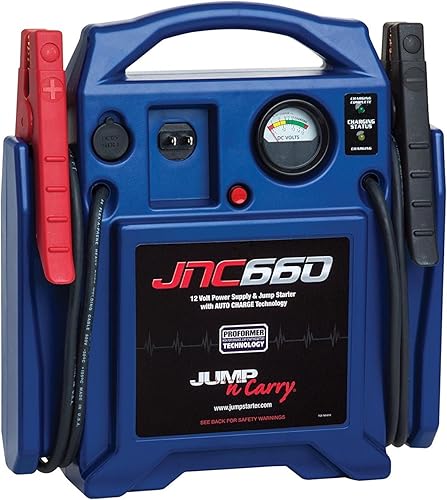
Clore Automotive Jump-N-Carry JNC660
Before lithium took over, boxes like this were the standard — and plenty of shops, tow trucks, and fleets still run them for good reason. The JNC660 is a sealed lead-acid unit with long, heavy cables and genuinely strong sustained cranking power, built to jump large engines over and over without babying it. It's not the tool for someone who wants to toss something in a glovebox and forget about it, but for a garage or a truck that jumps vehicles regularly, the proven lead-acid format still earns its keep.
Pros
- Extremely proven, shop- and fleet-grade design
- Long cables and strong sustained cranking power
- Handles repeated large-engine starts without strain
Cons
- Heavy and bulky compared to any lithium unit here
- Needs regular top-off charging or it goes flat in storage
- No USB ports or power-bank features
Comparison at a Glance
| Jump Starter | Type | Best engine size | Extras | Best for |
|---|---|---|---|---|
| NOCO Boost Plus GB40 | Lithium | Up to mid-size gas | Spark-proof clamps, USB out | Everyday glovebox unit |
| NOCO Boost HD GB70 | Lithium | Large V8 / diesel | Built-in light, USB out | Trucks and diesel owners |
| Hulkman Alpha85 | Lithium | Large V8 / diesel | Big display, power-bank mode | Buyers who want feedback and features |
| GOOLOO GP4000 | Lithium | Mid-size to large gas | High peak-amp rating | Budget-conscious high output |
| Clore Jump-N-Carry JNC660 | Lead-acid | Large engines, repeated use | Long cables, rugged case | Shops, fleets, frequent jumps |
FAQ
How long does a jump starter hold its charge in storage?
Lithium units typically hold a usable charge for months without being touched, though it's good practice to top them off every couple of months so you're never caught with a dead unit. Lead-acid units self-discharge noticeably faster and really do need scheduled charging — many owners plug theirs in monthly — or they'll be flat when you need them.
Is it safe to leave a lithium jump starter in a hot or cold car?
For normal seasonal swings, yes — that's part of the appeal over lead-acid. Extended exposure to extreme heat, like a dashboard baking in direct summer sun, will shorten any lithium battery's long-term life faster than a shaded console or trunk would. Very cold temperatures can temporarily reduce output, so bringing it inside overnight before a predicted deep freeze isn't a bad habit if you have the option.
Can a jump starter damage my car's electronics?
A quality unit with spark-proof clamp technology and reverse-polarity protection is built to prevent exactly that — it won't energize the clamps until the connection is verified correct. The risk comes from cheap, unprotected units or user error like reversed clamps on a device that lacks that protection. Buy a starter that has both features and follow the connection order in its manual.
Lithium vs. lead-acid — which should I actually buy?
For most drivers, lithium: it's smaller, holds a charge longer in storage, and often includes USB power-bank features. Lead-acid still makes sense if you're jumping vehicles often — a shop, a tow operation, a fleet — where sustained, repeated high-current output matters more than size and where someone is already maintaining a charging routine for the equipment.
Battery Keeps Dying?
A jump starter gets you moving today, but if the same battery keeps dying, the box in your trunk is treating a symptom. It could be a bad battery, a failing alternator, or a parasitic draw — worth ruling out before you buy a bigger starter. Run it through the free WrenchConnect AI diagnostic, check your symptoms for other clues something's off, or find a trusted local mechanic to track down the drain for good.